| August 12, 2013
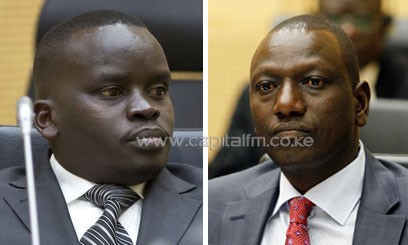
Prosecutor Fatou Bensouda has lined up 42 witnesses against William Ruto (R) and Joshua arap Sang (L)/CFM
This emerged on Monday as Trial Chamber V (a) which will hear the trial against the two issued ground rules and procedures, in which it mentioned the prosecution’s request to be given 413 hours to present its evidence and use 42 witnesses during the trial expected to kick off on September 10.
“The prosecution has submitted estimates of the length of time it requires to question each of its witnesses. It also indicated that it would call 46 witnesses and would require 413 hours in total for the examination-in-chief of those witnesses. As a result of subsequent changes, there are currently 42 witnesses whom the prosecution intends to call,” the judges explained.
However, the time requested by the prosecution will be contested at a status conference to be arranged before the start of the trial against the two.
“Having compared practice and experience in the other cases before the court, the chamber is of the view that the prosecution’s estimates appear excessive. At the next status conference to be held, the chamber will seek the parties’ and participants’ views on this issue, with a view to reducing the prosecution’s estimates,” the judges said.
In the set of rules, the trial chamber directed the prosecution to remove names of witnesses who had withdrawn.
Having compared practice and experience in the other cases before the court, the chamber is of the view that the prosecution’s estimates appear excessive.
“The prosecution is further directed to provide, prior to the commencement of trial, an updated list of witnesses listing all witnesses in the expected order of call. The updated witness list should also delete any withdrawn witnesses and include revised estimates of examination time should the chamber order reductions during or after the forthcoming status conference,” the judges decided.
The chamber further asked the prosecution to inform the court of the facts that each witness will give and show the “relevance of the testimony relative to the charges.”
The prosecution was also required to furnish the court with an updated witness schedule on a monthly basis starting September.
The judges noted that so far, the prosecution had provided a list of 10 witnesses that it expected to use in the trial against Ruto and his co-accused Sang.
In regards to the opening statements of which Ruto and Sang will have to be present in person, the judges ruled that the prosecution will be the first to give its opening statement, followed by victims’ legal representative.
Ruto’s and Sang’s defence opening statements will then follow respectively.
The opening statement of each party will take up to a maximum of two hours.
The defence teams in the Ruto-Sang case were also asked to disclose to the court and other parties in the case copies of material they will use by 5 September if it was not in the possession of the prosecution’s evidence.
The judges also agreed that only the charges section of the Document Containing Charges will be read out during the opening session of which Ruto and Sang defence teams will be required to submit certified declarations on that issue by August 29.
The judges said that any objection notices by either of the parties should be filed by August 26.
"The chamber will, in principle, permit the defence to enter submissions, at the close of the case for the prosecution, asserting that there is no case for it to answer at the end of the prosecution’s presentation of evidence."
The judges also allowed the defence teams to file motions of ‘no case to answer’ after the prosecution present its evidence.
“The chamber will, in principle, permit the defence to enter submissions, at the close of the case for the prosecution, asserting that there is no case for it to answer at the end of the prosecution’s presentation of evidence. The chamber will in due course give both its reasons for permitting this manner of procedure and further guidance as to procedure and applicable legal test,” the judges asserted.
Whereas Sang will be present throughout the trial sessions, the trial chamber allowed Ruto to attend some sessions which include the opening and closing statements of all parties.
The decision was however challenged by the prosecution and the Appeal’s Chamber is yet to give its verdict if Ruto should attend all the sessions or will skip some sessions.
The trial against President Uhuru Kenyatta is set to begin on November 12.


 Posts
Posts


No comments:
Post a Comment